Technical Foundations
Crawlability, indexation, page titles, meta descriptions, canonical URLs, and site speed — the basics search engines rely on to find and understand a site.

Connect technical foundations, keyword and intent mapping, internal linking, and local search into one coherent SEO strategy.
Save or follow this source
Add AdvocateRahulDev.com to Google Preferred Sources or open this page in your preferred AI tool.
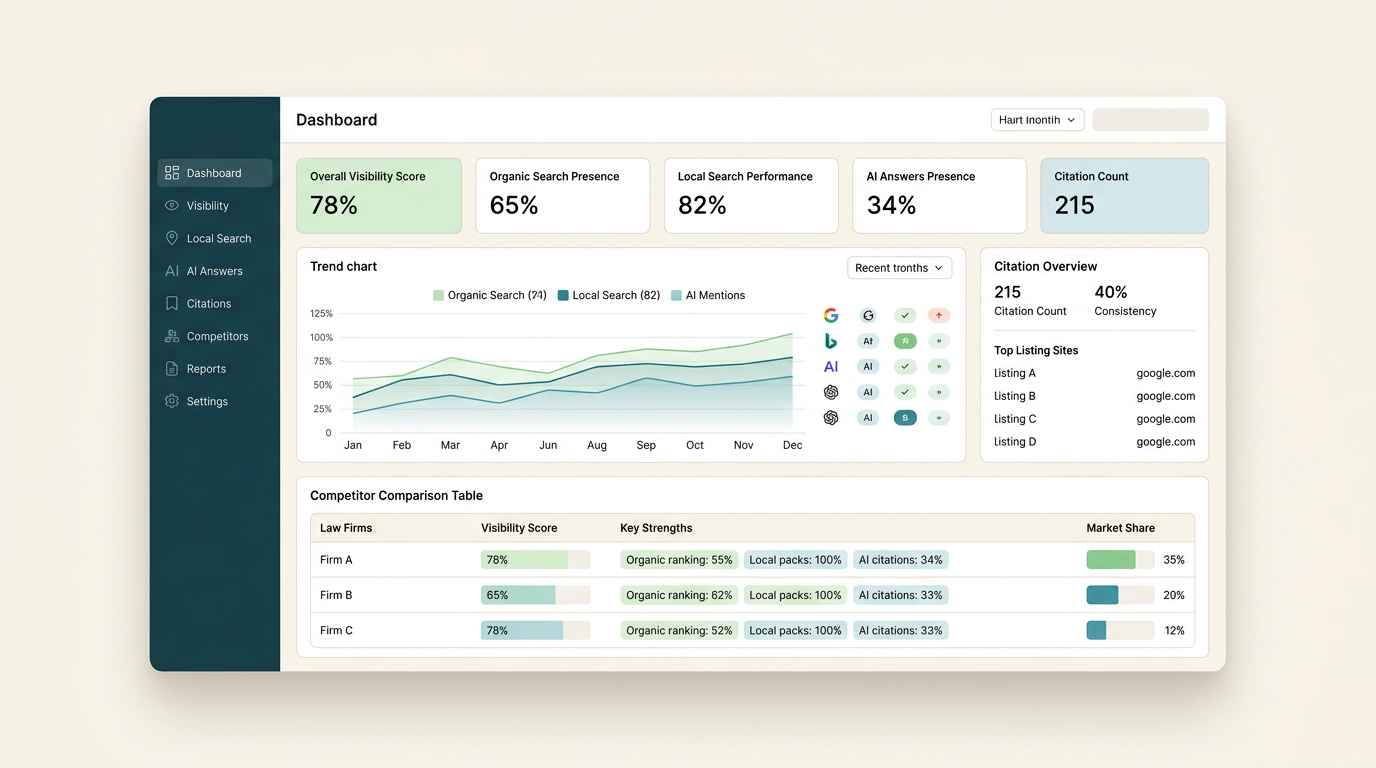
A firm can have strong lawyers and clear services and still fail to appear for the searches that matter. This usually isn't a keyword problem. It's a structural one: unclear page roles, weak internal linking, thin or duplicated content, and no consistent local signal for firms serving specific regions.
Crawlability, indexation, page titles, meta descriptions, canonical URLs, and site speed — the basics search engines rely on to find and understand a site.
Assign each page a distinct search intent so pages support rather than compete with each other.
Connect hub pages to supporting content so search engines and users can navigate the relationship between subjects.
Google Business Profile accuracy, location pages, and consistent business information for firms serving defined geographic areas.
Build pages substantial enough to earn visibility rather than repeating generic industry language.
The offering is defined, but the site isn't being found for the searches that matter.
Competitors are visible for the same terms and the firm needs to close a specific gap.
New geographic or practice-area visibility requires a plan, not just a few new pages.
A common question is whether AI Overviews and AI-driven search require a separate strategy. According to Google's own guidance on generative AI features, these results are generated using the same core Search ranking and quality systems used for traditional Search results — there is no separate ranking system to optimise for. That means the SEO fundamentals covered here — technical health, clear intent mapping, and genuine content depth — remain the foundation, whether a result is displayed as a traditional link or an AI-generated summary.
Last updated: July 31, 2026
Law firm SEO is frequently reduced to keyword insertion, but the more important task is architectural: deciding which page should answer which query, ensuring supporting pages connect to the right hub, and building enough genuine depth and credibility into each page to justify its visibility. Technical foundations, intent mapping, and local search all play a role, and none of them work well in isolation.
Direct answer: Law firm SEO is the technical, structural, and editorial work that helps a firm's priority pages get discovered for relevant searches, covering crawlability, keyword and intent mapping, internal linking, local search, and content depth, rather than isolated keyword insertion.
It's tempting to treat SEO as a checklist of keywords to insert into existing pages. In practice, the more consequential decisions happen earlier: which page on the site should be the authoritative answer for a given query, how that page relates to sibling and parent pages, and whether the site as a whole gives search engines a clear signal about what it covers and how thoroughly.
A firm can place the right keyword on a page and still fail to rank if three other pages on the same site compete for the same intent, or if the page lacks the depth a searcher — and a search engine's quality systems — would expect from an authoritative source. Architecture-first SEO addresses this by assigning intent deliberately rather than reactively.
Search engines can only rank content they can find, crawl, and understand. Google's SEO Starter Guide lays out the fundamentals that underpin visibility: sites need to be crawlable and indexable, use unique and descriptive titles and meta descriptions, maintain a logical site structure, and provide content that gives searchers a genuine reason to choose that page.
For a law firm, this translates into concrete requirements: correct canonical tags to avoid duplicate-content confusion, sitemaps that reflect only indexable pages, clean URL structures, and page speed that doesn't create friction for mobile visitors. These fundamentals rarely change quickly, and Google has been explicit that they remain relevant even as AI-driven search features have grown.
Every page on a law firm website should be assigned a distinct search intent before content is written. This prevents the common problem of multiple pages — a service page, a blog post, and a topic hub — all targeting the same query and diluting each other's visibility.
Mapping intent also clarifies what "supporting content" actually means. A topic hub page should link to the guides, resources, and solutions that deepen a specific subject, while a commercial service page should stay focused on conversion rather than trying to also serve as the definitive educational resource on the topic.
For firms serving a defined geographic area, local search behaves differently from general organic search. Google Business Profile accuracy, consistent business information across directories, and location pages that provide genuine local context — rather than the same generic service description repeated for each city — all influence whether a firm appears for "near me" and location-qualified searches.
Local SEO should be planned alongside the site's broader architecture rather than treated as a separate initiative, since location pages often need to connect back to the same service and topic hub structure as the rest of the site.
A frequent question is whether AI Overviews and AI Mode require a separate SEO approach. According to Google's own guidance on generative AI features in Search, these features are powered by the same core ranking systems used for traditional Search results. There is no separate technical track built specifically for AI-generated summaries. Google has also directly stated that specific "AI optimisation" files, such as llms.txt, are not used and are ignored by Google Search.
In practice, this means the technical foundations, clear intent mapping, and genuine content depth described above remain the relevant work, regardless of whether a search result is displayed as a traditional link or an AI-generated answer.
The fundamentals are the same, but law firm SEO must also account for local search relevance, the need for clear lawyer and practice-area distinctions, and content depth appropriate to legal subject matter.
No. Google has confirmed these features use the same core ranking and quality systems as standard Search, so the same fundamentals apply rather than requiring a separate technical approach.
Timelines vary based on competition, the site's starting position, and the scope of work, and no specific timeline can be guaranteed. Search engines control indexing and ranking independently of any individual campaign.
Local SEO affects visibility for geographically qualified searches through Google Business Profile accuracy, location pages, and consistent business information across the web.
Yes, to a degree. Technical foundations, internal linking, and intent mapping can improve visibility for existing content. That said, genuine content gaps typically still need to be addressed over time.
Additional context on legal technology, search visibility, AI discovery and digital growth for law firms.
A focused review can clarify whether the constraint is technical, structural, local, or a matter of content depth.