Navigation and Information Architecture
Define the primary sections, their hierarchy, and how a visitor moves from a general question to a specific service.

Plan navigation, service hierarchy, lawyer profiles, performance and conversion pathways before a single page is designed or built.
Save or follow this source
Add AdvocateRahulDev.com to Google Preferred Sources or open this page in your preferred AI tool.
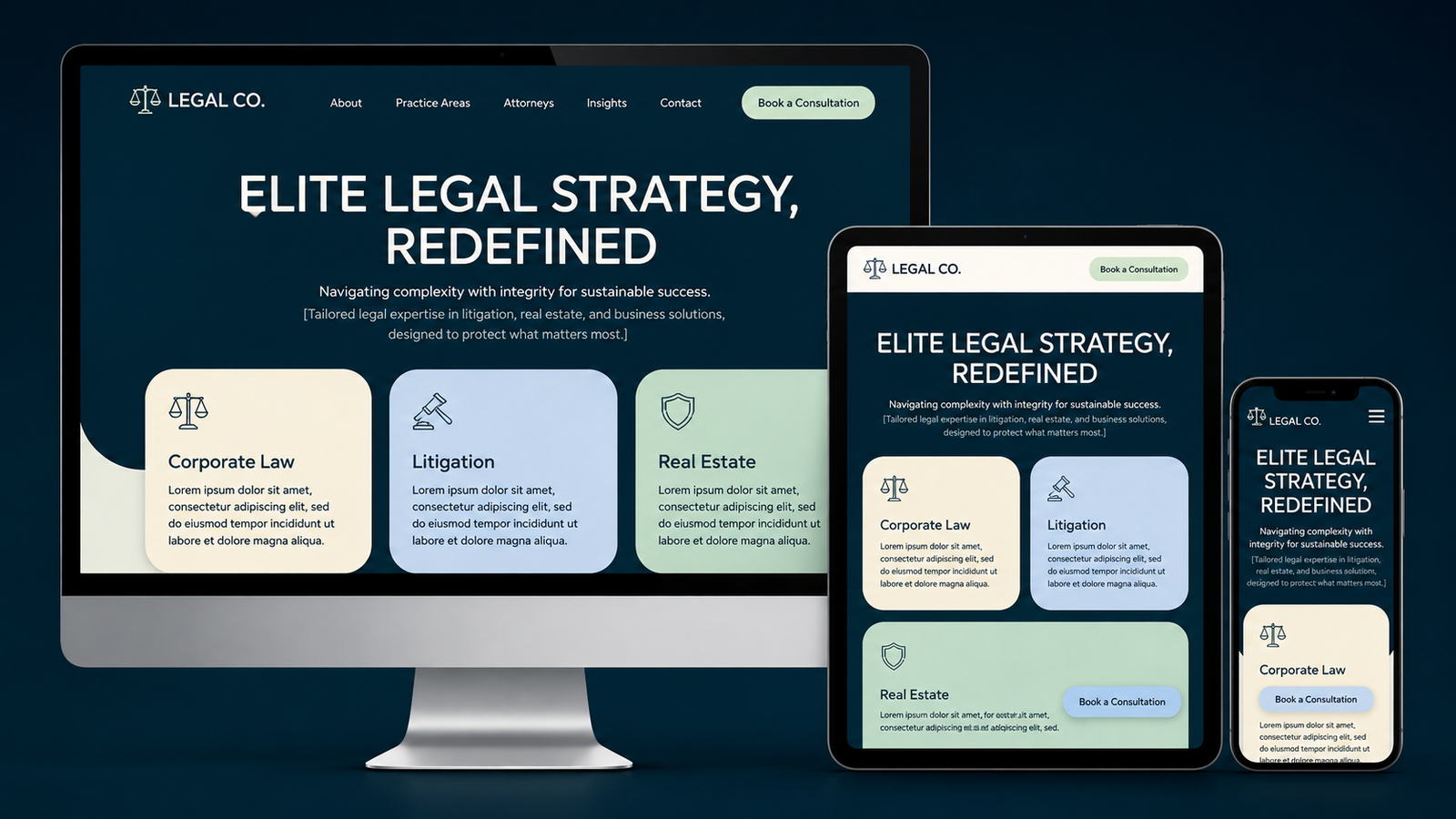
A new visual design does not fix a website that lacks a clear structure. Many law firm websites fail not because they look dated, but because the underlying architecture was never planned: services are unclear, lawyer profiles are thin, navigation reflects the firm's internal org chart instead of how prospective clients think, and content has been added page by page without a governing structure.
Define the primary sections, their hierarchy, and how a visitor moves from a general question to a specific service.
Decide which pages answer which queries, and how service pages differ in purpose from broader topic or practice-area pages.
Establish what every lawyer profile must include: experience, credentials, subject areas, and a clear route to contact.
Map how topic hubs, resources, and insights will connect to and support commercial service pages.
Address mobile usability, page speed, accessibility, and crawlability as architecture decisions, not afterthoughts.
Match calls-to-action to where a visitor is in their research, rather than repeating the same CTA on every page.
Define the structure before a designer or developer begins, so decisions about SEO, content, and conversion are built in rather than retrofitted.
Identify what should be preserved, corrected, or removed, rather than starting over without understanding what already works.
Extend the architecture in a way that avoids duplicate content and keyword cannibalisation as the site grows.
| Standard Redesign Brief | Website Strategy |
|---|---|
| Starts with visual direction | Starts with architecture and navigation logic |
| Pages added as requested | Pages planned against defined roles and intent |
| SEO addressed after launch | SEO and content structure built into the plan |
| One generic CTA repeated | CTAs matched to each page's role in the client journey |
Last updated: July 31, 2026
A law firm website often underperforms not because of its visual design, but because no one defined its structure before it was built. Website strategy addresses navigation, service hierarchy, lawyer profiles, technical foundations, and conversion pathways as planning decisions, made before development begins rather than corrected afterward.
Direct answer: Law firm website strategy defines navigation, service hierarchy, lawyer profiles, and conversion pathways before design or development begins, so that search visibility, content structure, and user trust are built into the architecture rather than retrofitted after launch.
A website redesign commissioned without a structural plan tends to repeat the same problems in a new visual wrapper. Pages get carried over because they already exist, not because they still serve a purpose. Navigation is often built around how the firm is organised internally rather than how a prospective client actually searches for help.
This matters because the website functions as the connective layer between search visibility, content, and conversion. A site with unclear architecture makes every later decision harder: SEO cannot cleanly assign one page to one search intent, content has nowhere defined to live, and visitors struggle to find the next step regardless of how polished the design looks.
Strategy work exists to make these structural decisions explicit and intentional before a designer starts on layout or a developer starts writing code.
A defensible website architecture typically addresses several interlocking decisions rather than treating each page in isolation.
Navigation hierarchy. The primary navigation should reflect how a prospective client thinks about their problem, not how the firm's departments are organised. A visitor researching an employment dispute should not need to guess which of five overlapping menu items applies to them.
Content hub relationships. Service pages, topic hubs, resources, and insights each play a distinct role. A strategy defines how these connect: which hub a service page supports, which resources reinforce which topics, and how insights feed back into evergreen hubs without duplicating them.
URL and folder structure. Clean, descriptive URLs that reflect the site's logical hierarchy make the structure legible to both visitors and search engines. Restructuring URLs after launch is disruptive, which is why this decision belongs early in the planning process.
Conversion pathway mapping. Different pages serve visitors at different stages of research. A general educational page and a specific service page should not necessarily share the same call-to-action.
One of the most common structural failures is the absence of a clear distinction between a service page and a broader practice-area or topic page. A service page exists to convert a visitor who has already identified their need and is evaluating whether to contact the firm. A topic or practice-area hub exists to educate a visitor earlier in their research and to establish topical depth for search engines.
When these two page types are conflated, one of two problems tends to occur. Either the service page becomes too educational and loses its commercial focus, or the educational hub becomes thin because its content was diverted into a narrower service page. Website strategy resolves this by assigning each page a single, defined role before content is written.
Prospective clients evaluate the lawyers who would handle their matter, not only the firm as an abstract entity. A structural plan should specify what every lawyer profile must include: relevant experience, credentials, subject-matter focus, and a clear route to contact that specific person or team.
Inconsistent or thin lawyer profiles weaken trust regardless of how strong the rest of the site is. Website strategy treats profile standards as a structural requirement, applied consistently across every lawyer at the firm, rather than a page-by-page afterthought.
Technical foundations affect both user experience and search visibility, and they are far easier to build correctly from the outset than to retrofit. Google's own guidance on search fundamentals emphasises that a site should be easy for search engines to crawl, index, and understand, and that mobile usability, accessibility, and page speed are treated as baseline requirements rather than optional extras.
A website strategy should specify these requirements before development begins: how images are optimised and labelled, how the site behaves on mobile devices, how accessible the navigation is by keyboard, and how quickly key pages load. Addressing these after launch is possible, but it typically requires more in developer time than building them into the original specification.
A redesign typically focuses on visual design and updated pages. A website strategy defines the underlying architecture, navigation logic, and content relationships first, so that the redesign is built on a structural plan rather than repeating the previous site's structural problems.
There's no fixed number. The right count depends on the firm's services, practice areas, and locations, and should be driven by distinct search intents and genuine content needs rather than an arbitrary target.
In most cases, yes. Service pages are commercially focused and address a visitor ready to evaluate the firm. Practice-area or topic pages are broader and more educational, supporting search visibility and earlier-stage research.
Common causes include unclear navigation, service pages that compete with each other for the same search intent, thin lawyer profiles, and conversion pathways that don't match where a visitor is in their research.
A clear structure helps search engines and AI systems understand which page answers which query and how topics relate to one another. This supports both traditional search visibility and the entity clarity that AI-driven discovery systems rely on.
Additional context on legal technology, search visibility, AI discovery and digital growth for law firms.
A focused review can clarify whether the immediate priority is navigation, service-page structure, lawyer profiles, or technical foundations.