Service Pages
Define what the firm does and for whom, written to convert a qualified visitor into an enquiry.

Give service pages, topic hubs, resources, and insights a defined role so content builds authority instead of duplicating generic articles.
Save or follow this source
Add AdvocateRahulDev.com to Google Preferred Sources or open this page in your preferred AI tool.
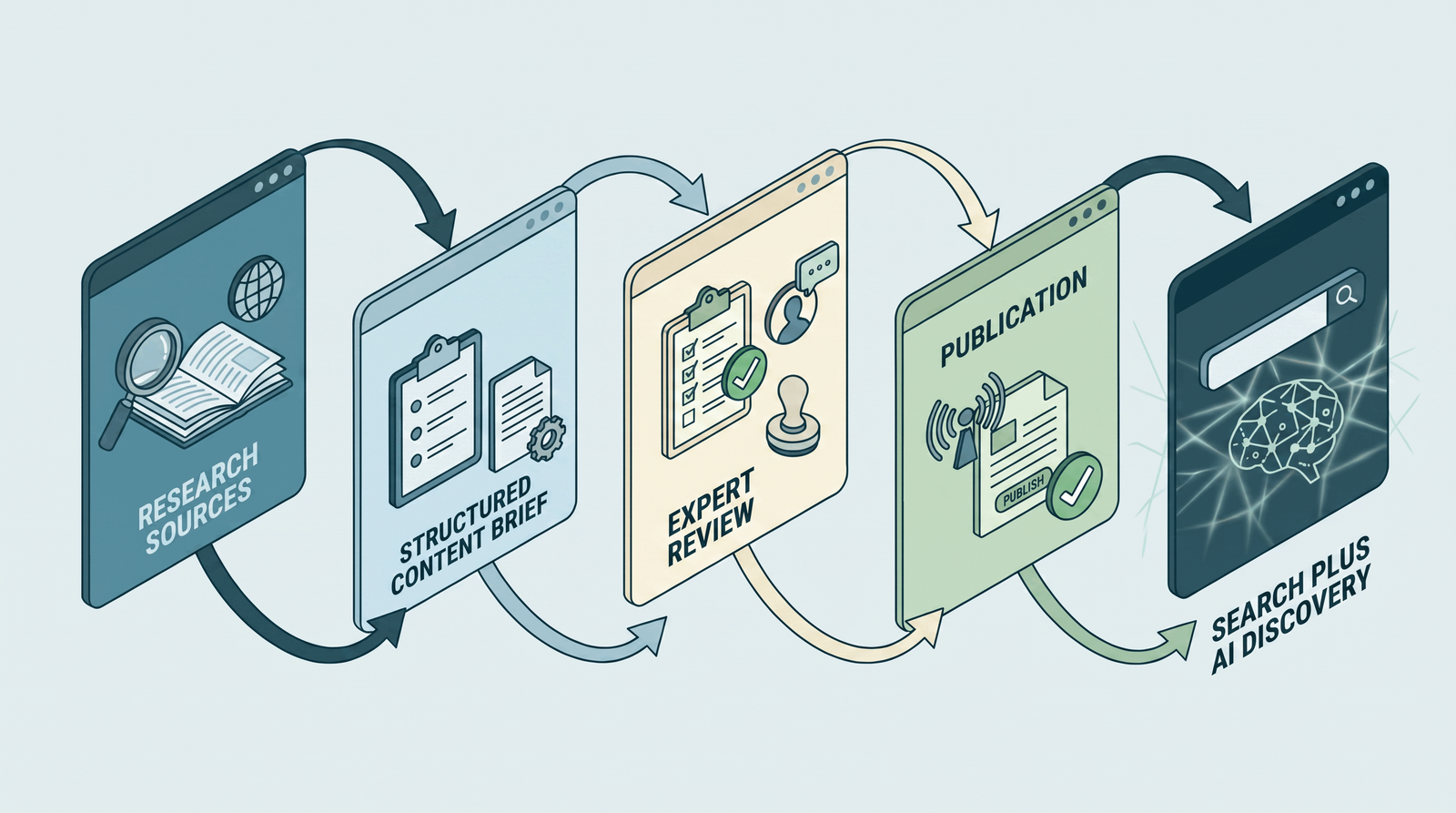

Many law firms publish inconsistently: a blog post here, a service page update there, with no governing structure connecting them. The result is often duplication, thin coverage of important topics, and no clear distinction between content meant to convert, content meant to educate, and content meant to answer a specific search query.
Define what the firm does and for whom, written to convert a qualified visitor into an enquiry.
Establish evergreen authority on a subject, linking to all relevant supporting guides and related solutions.
Checklists, templates, and reference material that help visitors apply what they've learned.
Timely analysis, commentary, and developments that keep the site current without duplicating evergreen hub content.
Content exists, but without a plan connecting individual pieces to a larger structure.
Articles could describe any firm in the industry, without reflecting specific expertise or experience.
Before increasing publishing volume, the firm needs a structure that prevents duplication and cannibalisation as the site grows.
| Ad Hoc Publishing | Structured Content Strategy |
|---|---|
| Topics chosen reactively | Topics mapped to a defined hub architecture |
| No consistent sourcing standard | Verified sources and transparent citations required |
| Pages compete for the same keywords | Each page has a distinct, assigned search intent |
| Authorship inconsistent or absent | Visible, consistent author attribution throughout |
Last updated: July 31, 2026
Publishing more content does not automatically build authority. A legal content strategy gives every page a defined role, connecting service pages, topic hubs, practical resources, and dated insights so that each format serves a distinct purpose rather than duplicating the others. This structure supports search visibility, client education, and AI readability without relying on volume alone.
Direct answer: Legal content strategy defines what a law firm publishes, why each page exists, and how service pages, topic hubs, resources, and insights connect, so that content builds search visibility and client trust instead of duplicating generic articles without a clear structure.
It's a common assumption that publishing more content leads to more visibility. In practice, a large volume of thin, duplicative, or generic articles often creates the opposite effect: search engines and AI systems struggle to identify which page is the authoritative source on a subject when several pages cover the same ground at similar depth.
A smaller, well-structured body of content — where each page has a clear, non-overlapping purpose — typically performs better than a larger collection of loosely related posts. This is the core argument for treating content as a structured system rather than an accumulating list of articles.
A structured content system typically separates four distinct formats, each with its own job.
Service pages exist to convert a visitor who has already identified a need and is evaluating whether to contact the firm. They should be commercially focused and specific.
Topic hubs establish evergreen authority on a broader subject. A hub should explain the scope of the subject, link to all relevant supporting guides, and connect to related solutions and resources, without competing with those supporting pages for the same search intent.
Practical resources — checklists, templates, worksheets — help a reader apply what they've learned. These are typically less time-sensitive than insights and more tactical than a hub overview.
Insights are dated, timely content: analysis, commentary, and developments. Insights should feed into and support the relevant evergreen hub rather than duplicating its core content in a different format.
Content that claims to be research-led needs to meet a real evidentiary standard. This means separating verified facts from analysis and clearly flagging unresolved or uncertain areas, rather than presenting all claims with equal confidence.
It also means not inventing sources, statistics, quotations, case studies, or outcomes. Material claims should be supported by inline contextual links, and a source list should be included where research forms the basis of the content. This discipline protects the credibility of the entire content system — a single fabricated statistic discovered by a reader damages trust in every other page on the site.
Structured content supports AI-driven discovery in the same way it supports human readers: through clarity. Content organised around clear headings, direct answers to specific questions, and a logical relationship between hub and supporting pages is easier for both humans and AI systems to interpret accurately.
This is not a separate technical requirement layered on top of good content practice. Clear structure, genuine depth, and honest sourcing serve search visibility, reader trust, and AI interpretability simultaneously, which is why content strategy treats these as one integrated discipline rather than three separate concerns.
A topic hub is a structured, evergreen overview of a subject that links to all its important supporting pages and stays current over time. A blog is typically a chronological stream of dated posts without the same structural relationship to a broader subject.
There's no fixed target. The right amount depends on how many distinct search intents and client questions the firm's services genuinely warrant, not an arbitrary publishing schedule.
Generally, yes, where the practice area is significant enough to warrant its own topic hub, service pages, and supporting content. Smaller or less central practice areas may be covered more briefly without a full dedicated cluster.
Structured, clearly sourced content with direct answers is easier for AI systems to interpret accurately, in the same way it's easier for human readers to follow. This supports AI readability without requiring separate technical work.
Generic content could describe almost any firm without meaningful specificity. Authoritative content reflects the firm's actual expertise, cites real sources where relevant, and answers questions with genuine depth rather than surface-level summary.
No external sources cited on this page — content is grounded in the site's own established editorial standards rather than third-party claims.
Additional context on legal technology, search visibility, AI discovery and digital growth for law firms.
A focused review can identify duplication, thin coverage, and gaps between service pages, topic hubs, resources, and insights.